Good morning! Cathy at Loose Threads posted a link to a Norwegian site, which was so interesting that I just had to pass it along. For those of you who don't speak Norwegian... This summer, an almost complete wool tunic was found in Breheimen. The tunic is interpreted as a man's outer garment, worn with a belt and reaching down to the knees. It was found just by the edge of the glacier, where the ice has recently melted.
Check it out HERE, there are both pictures and videos!
Showing posts with label Archaeological/historical sources. Show all posts
Showing posts with label Archaeological/historical sources. Show all posts
Monday, October 17, 2011


Saturday, October 8, 2011
Textile Gallery with great pics of antique textiles
Good evening! Just today I came across this great webpage, and I immediately thought that I just have to share it with you all. Available in swedish and english, a textile gallery from Nordiska museet - Sweden's largest museum of cultural history. Especially those of you who are interested in 19th and 18th century textiles and embroidery... you have to check out the very detailed pictures in the textile gallery! Just type in a word such as "silk" or whatever and see what comes up. Have fun!
Wednesday, September 28, 2011
A bit off topic but I just gotta say it...8000 year old brain!
I just read this very interesting little post in the blog "Ting och Tankar", written by archaeologist Åsa Larsson. Since not all of you speak Swedish, let me summarize it for you...
The stone age excavations in Motala (in Sweden) have resulted in some very interesting finds. For example, skeletal remains appear to have been placed on poles, sticking out of the water, some 7500-8000 years ago.
Now what's REALLY interesting, is the lump of organic material inside one of the skulls... Which has turned out to be the remains of a brain!
Yes, you heard me. A brain. 7500-8000 years old! Isn't that incredible!? And they are currently analyzing it in the search for a method to detect brain damage in unconscious patients... Wonderful!
Monday, September 5, 2011
Lingonberry syrup part I: recipe from 1873
My favorite cook book is a worn little thing, published in 1873: Husmanskost. En hjälpreda för sparsamma husmödrar. ( which means approximately "Homely cooking for frugal housewives.") I got it from an antiquarian bookshop a couple of years ago, and immediately fell in love with it. One of the recipes that I've been longing to try out is called Lingonvatten med honung - "lingonberry syrup with honey".
Since my mother was kind enough to give me some lingonberries this weekend I could finally give it a go. The original recipe, translated to English (my translation) and with modern measurements, reads like this:
Lingonberry syrup
Ripe lingonberries are rinsed in water, carefully as not to break them (remove those that float with a perforated spoon), and let drain off on a clean towel. A copper cauldron is put on the fire with 15,6 l of water, dip a wooden stick in it and make a mark at the surface, then add another 15,6 l of water and 5,1 kg of brown sugar, and let it boil (removing the foam) until only 15,6 l remain as is shown by the stick. This sugar water is then poured into stone jars to cool down. The next day 15,6 l of the lingonberries are placed ín a well-flavored barrel , onto which the sugar water is poured, a bunghole is put in place and the barrel put in a room where it will be stirred every day. After 14 days 26 grams of cinnamon, 3, 25 grams of crushed and rinsed cardamoms, a piece of "violrot" (I couldn't find the English translation of this!), 33 cl of frensh wine is also added, the bunghole is once again fastened and the barrel put in a cellar. When it has rested for 6 weeks, the syrup is strained and poured into bottles, sealed with resin and stored in the cellar. At summertime this syrup is used to mix with drinking water.
Lingonberry syrup with honey
Treat the lingonberries as described above. 31,2 l of water is boiled in a clean copper cauldron. 3,9 l of honey and 0,65 l of water is boiled separately in a clean kettle, taken off the fire and foam removed, put back on the fire, taken off and foam removed, after which it is poured into the boiling water in the copper cauldron, but be careful not to let it spill over since the honey rises a lot. It is now boiled down 10,4 l, then the cauldron is taken off the fire, the syrup poured into stone jars which will rest until the next day. 15,6 l of lingonberries is then added to a barrel, the honey water is poured cold over them, after which they will be treated as described in the previous recipe.
So yesterday I prepared the sugar water and mixed it with the boiled honey, and today I added this mixture to the lingonberries. There is just one thing that I'm worried about... You see where it says to remove all the berries that float? Well... as I placed the berries in water about half of them float. Yup, half. And since I was already making a rather small batch (about one fourth of the original recipe) I didn't want to remove that much! The berries that float weren't bad in any way, they looked ok but I guess they weren't as ripe as those that sank to the bottom. So in other words, if the end result isn't good I have something to blame it on. That, or the fact that I didn't have a copper cauldron or stone jars, or even a wooden barrel (I had to make due with stainless steel and plastic...).
Next, I will have to stir the mixture every day for two weeks. I really really really hope that it wont get moldy... I'll keep you posted!
Tuesday, August 30, 2011
Iron Age event this weekend at Gamla Uppsala Museum
This weekend the Gamla Uppsala Muesum (yeah yeah, most people say Old Uppsala in English but frankly, I find it silly to translate place-names!) hold an Iron Age event and we are planning to attend together with a couple of friends. That, and a nice little phone conversation I had with Ida got me thinking about Iron Age fashion, the problems of Viking Age clothes (more specifically the female clothes) and purely practically speaking... what I should wear in Gamla Uppsala.
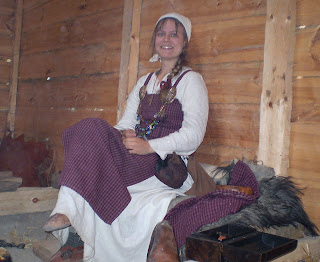 A couple of years ago I made a couple of Viking Age outfits according to the nowadays traditional interpretation: simple, long dress in linnen underneath and an apron dress in wool worn above. Why? I'm sad to say it was just because that's what people (fellow students, archaeologists and generally crafty people) told me was most correct. Sure, I knew that there were other versions as well but to be honest, I didn't really look into them at the time.
 Just a few years later I listened to a very interesting lecture by Dr Annika Larsson about her interpretation of the textile finds from a certain burial in Pskov, Russia. If I was to retell all of her theory this post would be way too long, so I'll settle for showing a picture. If you're familiar with the normal apron dress-type of dress I know this looks weird and wrong, but after hearing Annika's arguments and looking at pictures of the textiles from Pskov, I gotta say that I think she's onto something...
It is however very important to note that Annika never claimed that this was the only outfit used by Viking Age women. No, her interpretation is that this is an outfit for very specific events, probably ceremonial. So all those who refuse to accept this theory based on the "but that would be SO unpractical when you are working in the field" argument can just go away, please. =)
What the everyday Viking woman still makes me feel highly uncertain. Flipping through my old copy of Viking Clothing by Thor Ewing I found myself once again considering the more odd possibilities. For example, have a look at this carving from Oseberg (from the cart!).
"Around her neck hangs a very long double string of beads, and instead of the brooched dress, she wears a skirt and a blouse. The skirt appears to be belted at the waist and hangs in folds around the back: the front of the skirt is either covered by an apron or, more likely, hangs flat like a kilt front, and it appears to be patterned. The waisted, patterned skirt is strongly reminiscent of the shorter garment from Huldremose with its drawstring gathering." (Ewing 2006:46)
 I find this horribly interesting! If you've ever seen a reconstruction of this outfit then please tell me, because I'd love to see one! Now if you look at the male figure next to her... doesn't it look like he is wearing a sort of waistcoat? Either that or only the sleeves are pleated, with a smooth front. However, if you'd accept the interpretation of is as a waistcoat, then what is there to say that the woman isn't also wearing a similar garment, seeing that she too has pleating only on the sleeves but not on the front! Probably not, but I still think that there are more possibilities than the one Ewing suggests, and I'd love to hear your thoughts on this as well.
 Considering the difficulties in interpreting the female Viking Age clothes, I'm not sure I want to wear my old apron dress to Gamla Uppsala. Continuing to wear it would only solidify the general view of it as 'the' Viking Age dress, and I'm not sure I want to be a part of that... So what to wear? One possibility is to make a simple garment suitable for a slave woman, sleeveless and probably only kneelength (Rigstula describes the slavegirl as having tanned arms, suggesting a dress without sleeves, and there are pictures of simple dresses only reaching down to the knees...). Or I go for something completely different! The event isn't Viking Age, it's Iron Age! So why not come dressed in an outfit from the early Iron Age? The marvellous finds from Danish bog bodies offer enough textile remains for a good reconstruction! Then as far as I can tell, I should probably make myself a peplos or a waisted skirt like what they have found in Huldremose, Denmark. Since a peplos seems to be the easiest to make (I only have a few days and lots of other stuff to do as well!) I think that's what I'll choose. That, and the fact that I can't find ANY pictures of the other outfit where you can actually see what's worn below the cape. A tunic? A dress that stretches down below the skirt? Nothing? *giggling* Well... since my mind seems to be going around in circles I think I'll just stop this rambling. If I can just get rid of this horrible cold that's been keeping me in bed I'll go get some nice wool for a peplos. And no, I wont have time to sew it by hand, so don't even think about it!
Have a great day and as usual, I'd love to hear your thoughts on this so feel free commenting!


It is however very important to note that Annika never claimed that this was the only outfit used by Viking Age women. No, her interpretation is that this is an outfit for very specific events, probably ceremonial. So all those who refuse to accept this theory based on the "but that would be SO unpractical when you are working in the field" argument can just go away, please. =)
What the everyday Viking woman still makes me feel highly uncertain. Flipping through my old copy of Viking Clothing by Thor Ewing I found myself once again considering the more odd possibilities. For example, have a look at this carving from Oseberg (from the cart!).
"Around her neck hangs a very long double string of beads, and instead of the brooched dress, she wears a skirt and a blouse. The skirt appears to be belted at the waist and hangs in folds around the back: the front of the skirt is either covered by an apron or, more likely, hangs flat like a kilt front, and it appears to be patterned. The waisted, patterned skirt is strongly reminiscent of the shorter garment from Huldremose with its drawstring gathering." (Ewing 2006:46)
 I find this horribly interesting! If you've ever seen a reconstruction of this outfit then please tell me, because I'd love to see one! Now if you look at the male figure next to her... doesn't it look like he is wearing a sort of waistcoat? Either that or only the sleeves are pleated, with a smooth front. However, if you'd accept the interpretation of is as a waistcoat, then what is there to say that the woman isn't also wearing a similar garment, seeing that she too has pleating only on the sleeves but not on the front! Probably not, but I still think that there are more possibilities than the one Ewing suggests, and I'd love to hear your thoughts on this as well.

Have a great day and as usual, I'd love to hear your thoughts on this so feel free commenting!
Saturday, August 27, 2011
Late 14th century illustrations - help me figure this one out!
Have a look at these two illustrations, dated to 1380-1400. Pretty, aren't they? Now look a bit closer at the ladies...


 First, I noticed this pretty lady whose outfit got me wondering. The lines seen around her arm and wrist as well as around her waist are just seams, or she is actually wearing a tight jacket of a sort, over her dress! Sewn in the same fabric as the dress, yes, but only reaching to her elbow and opening in the front. My first thought was that no, the lines are probably just the seams of the dress... But that doesn't really add up, does it? Ever seen a 14th century dress with seems like that? With no other seams at the skirt or anywhere else? And looking at the other garments from the same illustrator you can't really see seams like that either, can you? No, I can't see it as anything other than a separate garment.
Next, have a look at the hood. What a pretty chaperon, with a contrasting colour on the part covering the shoulders... But hang on, is this really a normal chaperon? Doesn't the colour of the hood and the shape of the front (under her chin) suggest that it's not actually attached to the purple cape, but to the garment below? Could this in fact be a hooded jacket of some sort, worn underneath a short cape?


In conclusion, I really don't know how to interpret these outfits. First, the possibility of a tight jacket worn over a dress... Have you ever seen anything like it? I don't think I have, but on the other hand I haven't really been searching for it either so I'm not sure. Then, have you ever seen the hood of a chaperon being attached to a jacket or a dress? Do you think it's a completely ridiculous idea or might there be something here for further research? And when it comes to the third lady here... sigh... can you make sense of it? With wide sleeves and tippets from just underneath the shoulders?
I'd love to hear your thoughts on this so please write me a comment! Do you see what I see or am I just a bit crazy here? The pictures are dated to 1380-1400 but unfortunately I haven't been able to find further information, but perhaps you know more?
And thank you for reading such a long post!
Thursday, June 9, 2011
Medieval embroideries worth millions of pounds... wow...
Check out this link, it's an article from the guardian about a rather fascinating case of lost and found... Apparently two medieval embroideries were found in an old lady's appartment in Mayfair, London. The finder had no idea of the age and worth of these embroideries, but as he took them to an expert who estimated their value to "hundreds of thousands, if not millions of pounds"... Just imagine finding a national treasure like that! *jealous* I haven't found any pictures of the embroideries which is too bad, I really really really want to see them!
Saturday, May 7, 2011
Available for download, go check it out!
As many of you might already have seen, the York Archaeological Trust have made several great publications available for free download online! I suggest you go download it right away. I know I will... You can find all of it here.
For those interested in textiles there is "Textile Production at 16-22 Coppergate" by Penelope Walton Rogers (1997). If you are into leather then check out "Leather and Leatherworking in Anglo-Scandinavian and Medieval York" by Quita Mould, Ian Carlisle and Esther Cameron.
Also available for download is:
"Finds from Anglo-Scandinavian York" by Ailsa Mainman and Nicola Rogers
"Finds from Medieval York" by Patrick Ottaway and Nicola Rogers
AY 2/2:"York Bridgemasters' Accounts" Translated by Philip Stell (2003)
"Making Archaeology Matter:" by David Knight and Blaise Vyner
"Archaeology and Landscape in the Vale of York" by Mark Whyman and Andy Howard
Tuesday, January 18, 2011
The Neues Museum. What can I say?
At first glance this post may seem a bit off, considering the subject of this blog. But actually, it is right in line with the topics otherwise presented here. Craftsmanship. Art. Creativity. So if you have a few minutes to spare, and especially if you are interested in archaeology, I hope you will read what I have to say.
The Neues Museum in Berlin was severely damaged in WW2, but has now been restored and opened to the public. The size of the museum is impressive to say the least, and if you are planning a visit I'd recommend you not to plan on doing much else during that day, since it will definitely take a lot of time to go through. Which is marvellous, yay! A whole day spent around gorgeous archaeological artifacts! *happy dance*
As we walked into this impressive building we were struck by the simple things that makes a visit so much more pleasurable. Like the audio guide which is included in the entrance fee. And like being able to put your coat in a looked after wardrobe for free. So the museum went off to a really good start!
Unfortunately I can't say that the exhibitions were equally impressive. Now don't get me wrong, the items displayed are truly magnificent! So before I get into the problems give me a minute to ramble about the upside of the Neues Museum...The Egyptian section especially contains artifacts that display an astounding degree of craftsmanship. It was truly inspiring, both for me as an archaeologist and as a crafts enthusiast, to see such amazing work! All those faces, of people long gone, created by the hands of craftsmen (or rather, artists!) give me the chills...In a good way, for sure!
Marcus and I also found ourselves fascinated by the different techniques employed by the craftsmen. Neither of us have studied egyptology so our prior knowledge of this specific field is limited, but based on that limited knowledge and our own experiences we just had to play the guessing game. Had it been carved from solid rock? Had it been sculpted from clay? Had it it fact been molded? Marcus especially is very interested in the possibilites of the ancient egyptians molding "rock"... And I think he should post something about it, because I really can't explain the details.
Now, lets talk about Nefertiti. Yeah. Nefertiti. What can I say? Nefertiti. NEFERTITI.
The famous bust of Nefertiti was amazing. Usually when I view great archaeological artifacts I feel an intense happiness, like I feel all warm and fuzzy inside. But when I saw the bust of Nefertiti, I almost cried. Yes, to my own surprise, it really moved me. Both as an artifact and a piece of art. But woah, I really wasn't prepared for that!
Now for the not so uplifting part of this post. If you don't feel like reading negative critique then I suggest you stop here.
The audio guide, which seemed so very handy and great, turned out to be a huge disappointment. After a while I didn't even care about listening. And when I did listen I tended to get a bit upset.
Look at our gorgeous collection! What piece of art this is! Art history this, art history that. Art art art.
and
This man wrote a book about this. And this. Another man wrote this book. And this man discovered this. And then he discovered this. While writing this. Oh look, here's a great work of art. It was found by this guy, who then gave it to us! Us! Yes, he gave it to us! Aren't we great?
And then there were the instances when I got really irritated. On a wall, there were a whole bunch of scultped faces, all very similar. Very regal. The audio guide enthusiastically talked about how interesting they were, how good the artist was and what they said about style and art history. On the wall right next to them were another collection of faces. They were absolutely breathtaking, all individual, all spectacularly realistic. I felt like I was standing face to face with the real ancient Egyptians! Beeeaaauuutiful!
Then what did the audio guide have to say about them? Of course, the faces were clearly individuals, in contrast to the royal examples on the other wall. Since they were soooo different from the royal artwork the guide concluded that these were much less high standing. In fact, they barely qualifies as art.
Are you kidding me?! Barely qualifies as art?! But hold on, there is more! In contrast to the much appreciated royal artwork, there were "old, ugly and unhappy". I'm not joking, that's what the audio described them as. Old, ugly and unhappy!!! But Oh My God these were amongst the most beautiful sculptures I have ever seen! Old, ugly and unhappy?! Are you insane?!
Ok, just breathe...
To summarize... Based on the audio guide and most of the written information the Neues Museum isn't really interested in archaeology, despite being full of such amazing archaeological artifacts. But no, it's all about two things: Art history and the people who discovered the objects on display. No wait, three things: Art history,
the people who discovered the objects on display, and how great the Neues Museum is. In case you had missed it. And oh, I forgot to mention that the actual exhibitions, despite being brand new, appear to have been brought forth from the late 19th century. It was almost embarrassing... Old, ugly and unhappy. Yup, that's a good way of summarizing the Neues Museum. Old, ugly and unhappy.
Thursday, January 13, 2011
Medieval underwear from Schloß Lengberg
I just found a reference to a fairly recent archaeological find in Lengberg Castle in Austria, which included a whole bunch of textiles. Have a look at this link, in which it is mentioned that amongst the finds are several "nearly complete linen bras", and one that even has quite a modern look despite most likely having been made already in the 15th century! Now I have been searching for pictures of these bras but I can't find any. If you have any links or other info, please share them with me! I am incredibly curious!
Another interesting link, which I got from a stitch in time, shows a few pictures which are pretty interesting. Check out the panties, also from Lengberg Castle! Perhaps it is actually time to do some medieval underwear, instead of cheating like I have done so far?
Another interesting link, which I got from a stitch in time, shows a few pictures which are pretty interesting. Check out the panties, also from Lengberg Castle! Perhaps it is actually time to do some medieval underwear, instead of cheating like I have done so far?
Subscribe to:
Posts (Atom)